Bought Alibaba at $256 amidst the mess that Chinese tech companies are facing. I’m seeing this as a temporary drop in share price due to panic selling. Largely undervalue as compared to Amazon. Foreseeing that covid-19 has forced consumers’ purchase habit to rely more on online shopping, generating more sales than ever. This can be seen by recent 11/11 transaction. Also Alibaba has large investment stake in cloud data services which is bound to provide more revenue. This is a stock to hold forever, which is in line with my growth component in my portfolio.
One up on Wall Street
- Six categories of stocks
- Slow growers – Large and ageing companies expected to grow slightly faster than gross national product. Started off once as fast growers but mature now. Paid generous and regular dividends, stock price fluctuate within bounded range at slow pace. Sell when fundamentals deteriorate.
- Mid growers (Stalwarts) – Faster than slow growers, 10-12% annual growth in earnings. Buy for 30-50% profit and sell to repeat process. Sell when p/e gets too high.
- Fast growers – New enterprises that grow at 20-25% annually. Higher risks associated with these stocks. High fluctuations in price. Sell when p/e gets too high, check growth story and sales.
- Cyclicals – Company whose sales and profits rise and fall in regular if not completely predictable fashion. Expand, contract pattern. Coming out of recession and into a vigorous economy, cyclicals flourish, their stock price tends to rise much faster than prices of stalwarts. Timing is everything in cyclicals, only buy at the right cycle. Sell at end of cycle e.g. oil price goes up, inventory build up.
- Turnarounds – These are potential fatalities, waiting to spring a rebound. Sell after it turn around.
- Asset plays – These are company that’s sitting on something valuable that everyone has overlooked. It could be cash or real estate. It takes time to unlock the value, investors need to be patient.
Avoid:
- Avoid buying hottest stock in the hottest industry, it can fly and fall just as quickly. Profit could very quickly turn in to losses if you aren’t clever at selling hot stocks.
- Beware the next something stocks e.g. “Next Apple”, “Next netflix…” the list goes on…
Take note of:
- Earnings – earnings and stock price go hand in hand and in tandem. If one deviate from another, they will always return to normalization. Use PE ratio of compnay to determine valuation.
- Assets – Liquidate all your assets and minus off your debts – long term and short term and this is your book value.
- Understand the P/E of the market to determine the valuation of the market
- Understand future earnings of the company by:
- Reduce costs
- Raise price
- Expand into new market
- Sell more of its product in old market
- Dispose of losing operation
Numbers to note:
- If growth rate/PE by 1.5 is okay, >2 is better. Growth rate is defined by (growth of annual earnings compared to previous year earnings + dividend yield). I wondered how many such companies exist nowadays.
- E.g. $38 share with $20 in net cash/share. $38-$20=$18. If company is expected to earn $6/share, PE = 3 instead of 6.33.
- Watch out for debt: Equity to debt: 75/25%
- Buying stock based on book value need to understand what exactly was counted as part of book values.
- A 20% growth rate company A selling at 20 PE is always better than 10% growth rate company B selling at 10 PE.
- High profit margin for long-term stock. Low profit margin more advantageous in a successful turnaround.
Learnings from Common Stocks and Uncommon Profits
Capturing notes from reading of this investment book that is applicable to my investment journey.
15 points:
- Does the company have products or services with sufficient market potential to make possible a sizable increase in sales for at least several years?
- Does the management have a determination to continue to develop products or processes that will still further increase total sales potentials when the growth potentials of currently attractive product lines have largely been exploited?
- How effective are the company’s research-and-development efforts in relation to its size?
- Does the company have an above-average sales organization?
- Does the company have a worthwhile profit margin?
- What is the company doing to maintain or improve profit margins? Fisher stated, “It is not the profit margin of the past but those of the future that are basically important to the investor.” Because inflation increases a company’s expenses and competitors will pressure profit margins, you should pay attention to a company’s strategy for reducing costs and improving profit margins over the long haul.
- Does the company have outstanding labor and personnel relations? According to Fisher, a company with good labor relations tends to be more profitable than one with mediocre relations because happy employees are likely to be more productive. There is no single yardstick to measure the state of a company’s labor relations, but there are a few items investors should investigate. First, companies with good labor relations usually make every effort to settle employee grievances quickly. In addition, a company that makes above-average profits, even while paying above-average wages to its employees is likely to have good labor relations. Finally, investors should pay attention to the attitude of top management toward employees.
- Does the company have outstanding executive relations? Just as having good employee relations is important, a company must also cultivate the right atmosphere in its executive suite. Fisher noted that in companies where the founding family retains control, family members should not be promoted ahead of more able executives. In addition, executive salaries should be at least in line with industry norms. Salaries should also be reviewed regularly so that merited pay increases are given without having to be demanded.
- Does the company have depth to its management? As a company continues to grow over a span of decades, it is vital that a deep pool of management talent be properly developed. Fisher warned investors to avoid companies where top management is reluctant to delegate significant authority to lower-level managers.
- How good are the company’s cost analysis and accounting controls? A company cannot deliver outstanding results over the long term if it is unable to closely track costs in each step of its operations. Fisher stated that getting a precise handle on a company’s cost analysis is difficult, but an investor can discern which companies are exceptionally deficient–these are the companies to avoid.
- Are there other aspects of the business, somewhat peculiar to the industry involved, which will give the investor important clues as to how outstanding the company may be in relation to its competition? It is critical for an investor to understand which industry factors determine the success of a company and how that company stacks up in relation to its rivals.
- Does the company have a short-range or long-range outlook in regard to profits? Fisher argued that investors should take a long-range view, and thus should favor companies that take a long-range view on profits.
- In the foreseeable future will the growth of the company require sufficient equity financing so that the larger number of shares then outstanding will largely cancel the existing stockholders’ benefit from this anticipated growth? As an investor, you should seek companies with sufficient cash or borrowing capacity to fund growth without diluting the interests of its current owners with follow-on equity offerings.
- Does management talk freely to investors about its affairs when things are going well but “clam up” when troubles and disappointments occur?
- Does the company have a management of unquestionable integrity?
When to sell?
- When mistakes are made, own up to mistakes and sell even at loss.
- When failed the above 15 points.
- When better opportunities arise.
- Do not sell simply when price becomes overvalue because it is expected that growth companies are trading at higher valuation due to expectation that it will outperform in future.
- Do not sell simply because the stock has huge advance and it has lost it’s “potential” and it’s time to switch to another stock that hasn’t gone up.
Dividends
Many people in the personal finance community are enamored with dividend paying growth stocks, and with good reason. However, Fisher talks about why he prefers to invest in companies that don’t pay out dividends. His argument is that companies should focus on allocating their assets towards what will be most beneficial for their long-term growth. If a company pays out a significant amount of earnings to investors it limits the cash flow they have available and potentially slows the company’s growth. Ultimately Fisher doesn’t look for companies paying out the highest amount of dividends, he looks for consistency in a company’s policy.
Don’t
- Don’t quibble over eights and quarters – Buy at market price right away instead of saving that few dollars that could attribute to the stock running away. Should the stock not having potential in the first place, the investor wouldn’t be looking at it in the first place.
- Don’t over-diversify –
- (A) Large growth stocks – <20% in single counter
- (B) Mid-young growth stocks – <10% in single couner
- (C) Small companies with potential growth or loss <5% in single counter
- Don’t be afraid to buy during war
- Don’t focus on historical PE too much for growth company, but focus more on future earnings and growth
To be continued..
Happy new year 2020!
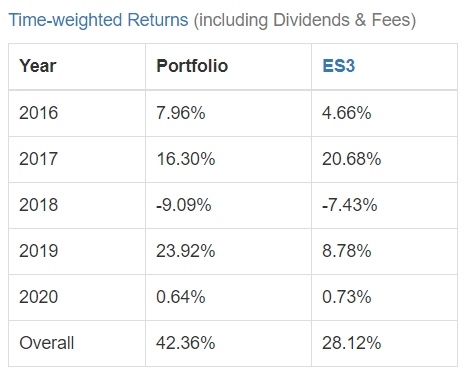
It has been a while since my last post here. 2019 was a good year for me in terms of my investment return from my portfolio. After losing out to the STI for the last two years, I managed to beat STI by quite a bit of margin. I once read a book that says that index are a difficult opponent that sometimes even a seasonal/professional investors have problem defeating them. I would recommend young investors to always look up to index (STI for example if you are investing in SG) as your target board to hone your skills.
Before i forget, Happy new year 2020 to all readers out there. My new year resolution is to once again defeat STI in 2020. It wouldn’t be a easy year, with the everlasting bull cycle seemingly coming to an year in near future. However on the positive side, this means opportunities are out there for us to collect cheap and heavily discounted blue chip stocks. Remember to always keep aside certain portion of your cash as your warchest in the event it happens. I’m allocating almost about 40% cash on hand at the moment and not spending unnecessarily in this overvalued market. Especially when you see DOW JONES going up every now and then and you better be feared than greed at this time.
Hope all of us can keep up the sharing and caring spirits in investing and let’s all invest prudently in this year for better returns.
Singtel: is it worth it now?
Singtel is one of my largest holding in my portfolio, partly due to her status as a gigantic blue chip and a consistent dividend payer. Now that the price has fallen over 30% from its recent high, it is time to look at it again.
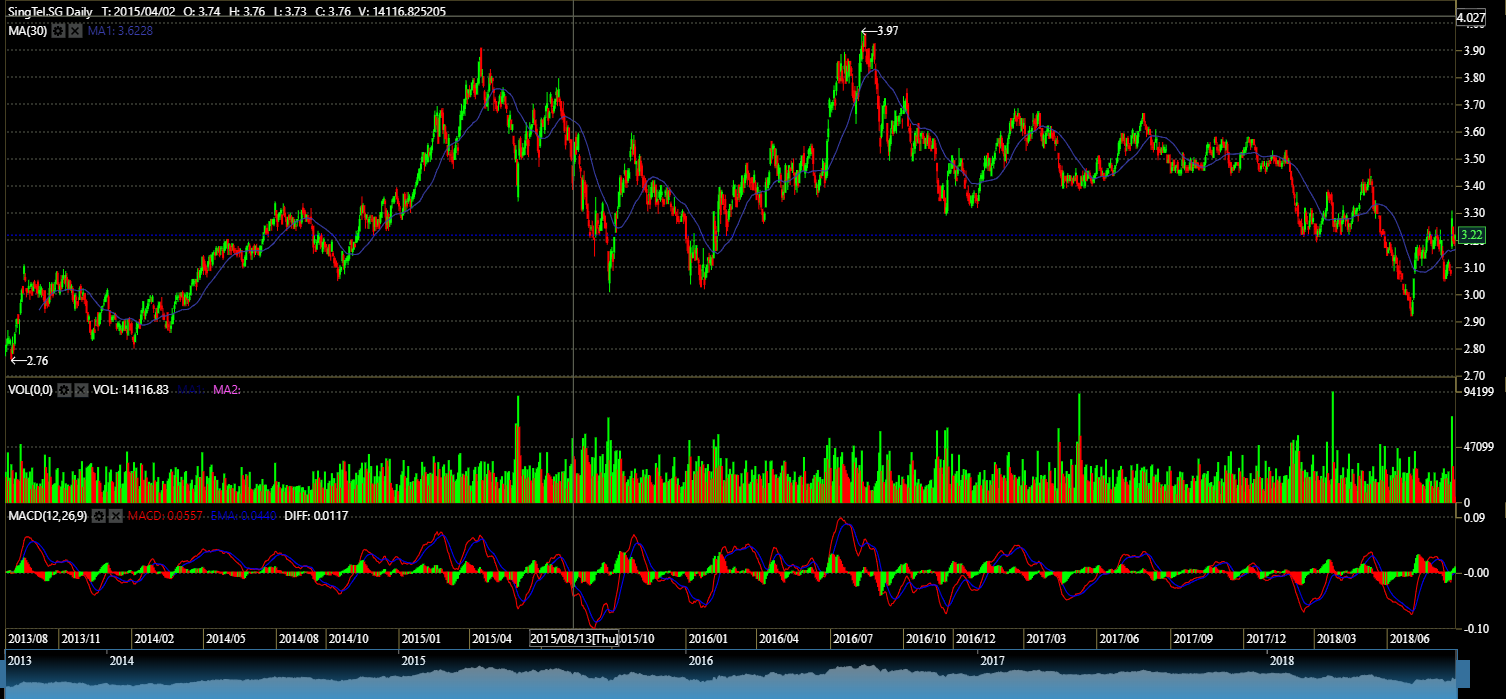
From fundamental point of view, the counter has been hit down due to competition from her diversified business everywhere and also in local context, the impending 4th telco and price war soon to come; have contributed to huge drop in the counter price. There isn’t any near term catalyst in view that might lift the price unless there is market consolidation or accretive acquisition that can grow the mammoth business. However any business can be owned at a good discounted price so long the business is still generating healthy cash flow and giving out good dividends. In this case, the management has committed to paying out 17cents per annual at least for the next 2 years.
Price wise, we should always buy with a margin of safety and in this case, it is hard to see huge revenue growth considering the top line of the business has been really flat in the last 10 years.
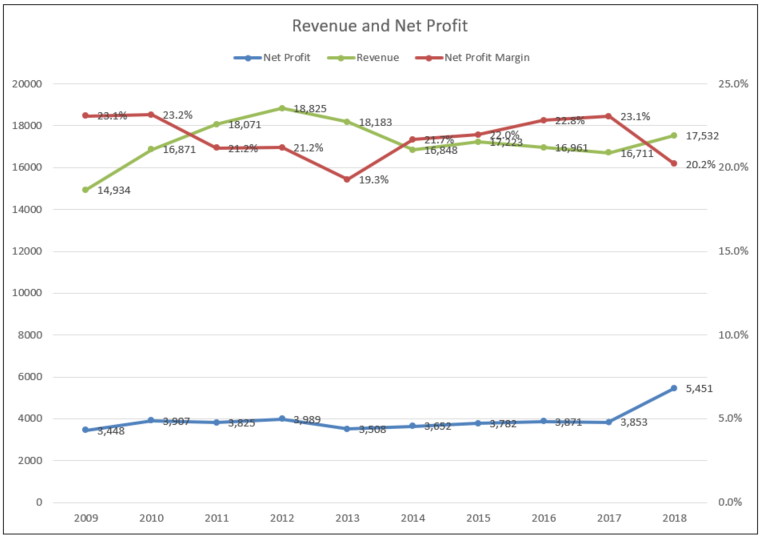
Assuming no growth and the eps remains at 10 years average of 0.23c per share (excluding any exceptional earnings), historical 10 year p/e of 15 will give a share price of $3.45. I would prefer at least a 10% MoS considering the entry of the 4th telco and the fierce competition ahead for the regional business, this results in a fair price of $3.10. At $3.10, 17c gives a yield of 5.5% with room for growth considering the 10% MoS allocated for this price. Any drop below this price to me is a fantastic opportunity to scoop up a mammoth blue chip giving a dividend of at least 5.5%.
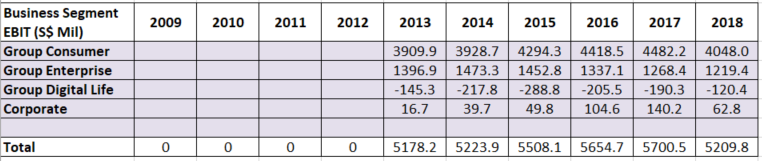
Any growth driver should come from the acquisition of good businesses that can improve the top line of the company. There should still be enough ammunition for singtel to do that following the divestment of Netlink. However my personal thought is that management will need to be more aggressive on the digital life and enterprise business segment to generate a steady stream of income that can be comparable to their current traditional consumer business.
August Transaction: First REIT
Bought into First Reit again after recent low. The selling happened because of the depreciating Indonesia rupiah and the recent financial trouble in their sponsor Lippo Karawaci, which could probably liquidate some of their assets to free up cash.
However the track record of the reit is here to see. With a built-in annual rental escalation clauses in their assets, this helps to mitigate the rising interest. Furthermore, rental income derived from Indonesia is pegged to the Singapore dollar, this mitigates the forex risk. The year on year increase in DPU and distribution help cushion my income portfolio by providing consistent dividends.
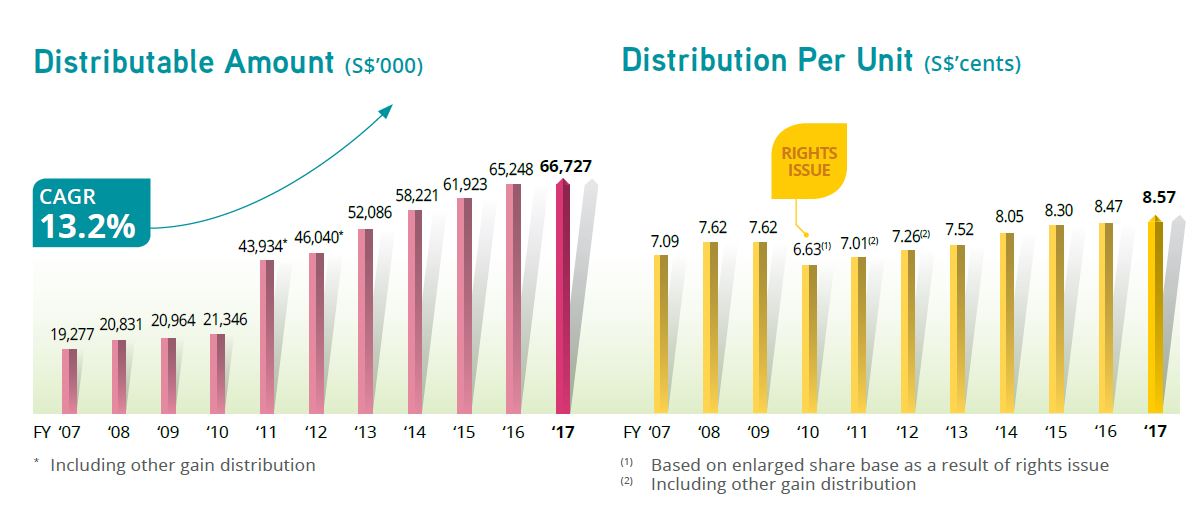
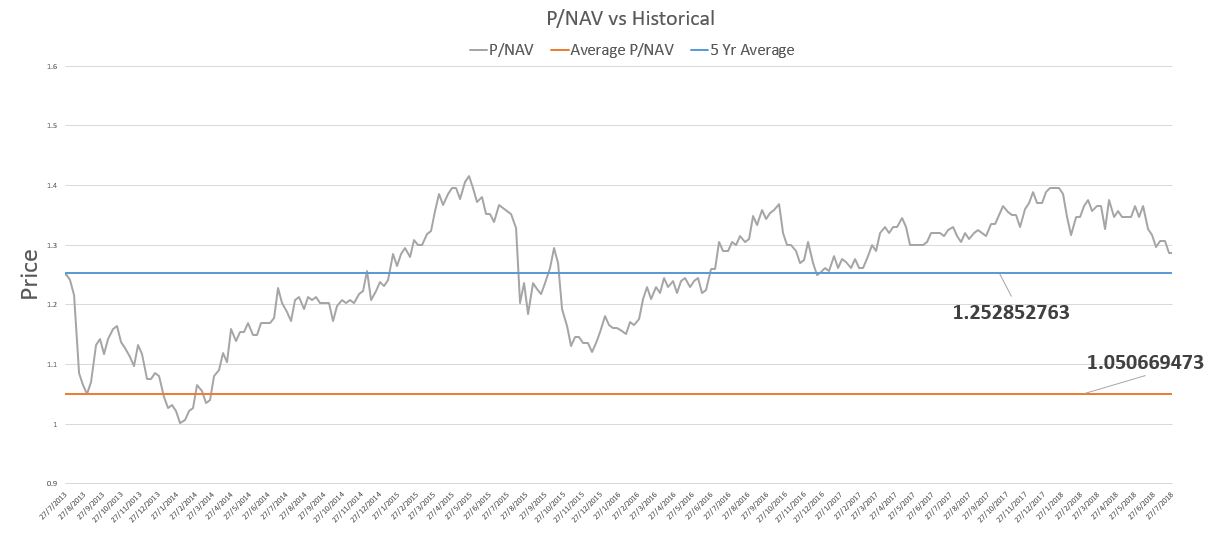
At $1.28 a share, the estimated annual DPU of 8.57c (based on 2017) provides a 6.7% yield for an equity in healthcare sector. P/B is slightly high though at 1.26 as compared to 10 years P/B average. It is closer to 5 year P/B average of 1.25.
My view is that this provides a good level of support and good dividend to hold.
An engineer investment journey begins
This is a blog created to log an engineer journey of investment, stock purchases, opinions and ideas in the equity market. I’m pretty sided to the other half of the investing philosophy used by many investor – value investing. Finding discounted counters at a beaten down price, uncover their fundamental by vetting the annual reports, monitor them in my watchlist and finally adding them to my income portfolio. I find little interest in selling them because i believed the income portfolio will provide me a strong passive income generator once i retired.
I shall end this blog post by providing a quote from Warren Buffett’s right hand man:
“Like Warren, I had a considerable passion to get rich, not because I wanted Ferraris – I wanted the independence. I desperately wanted it.” — Charlie Munger


